"A derivation clause is required in the legal description."
That single sentence sits inside Houston County's recording requirements for deeds, tucked between font-size rules and margin specifications. It reads like the kind of bureaucratic fine print nobody thinks about until it stops a closing cold. But it points at something true about buying rural acreage near Gordon: the paperwork that actually determines what you own and what you'll pay doesn't get finished at the closing table. Most of it gets finished afterward, at the county courthouse in Dothan, on deadlines the purchase agreement never mentions.
That's the part buyers on unfenced timber and river-bottom tracts around Gordon tend to miss. The deed gets signed, the check clears, and everyone assumes the transaction is over. In practice, closing day just starts a set of separate clocks: one at the Probate Office that determines whether your deed even records, one at the tax assessor's office that determines what rate you'll pay next year, and one buried in the chain of title that determines whether you actually own everything beneath the surface. None of these show up on a settlement statement.
The Deed Has to Satisfy the Probate Judge Before It Satisfies You
Every deed for land in Gordon gets recorded through the Houston County Probate Office at 462 North Oates Street in Dothan, under Judge Patrick H. Davenport. That office isn't a rubber stamp. It has specific formatting and content requirements, and it will bounce a deed that doesn't meet them.
The legal description has to be written by metes and bounds, and it has to include that derivation clause, a line showing where the current owner's title came from. If the deed instead describes the land by referencing a plat, the actual plat has to be physically attached, along with the book and page where it's filed. The document has to name and address whoever prepared it. And Alabama law requires the deed to state the grantor's marital status, a small detail that gets missed more often than you'd expect on deals handled without a real estate attorney.
None of this is unique to Gordon. It's Houston County's standard, and it applies to every acre from the tracts off Gus Hughes Road to the parcels near the Lucy Community. But it matters more on land deals than on in-town home sales, because rural tracts are more likely to have been carved up, subdivided, or passed through a family for generations, which means the legal description has more room to go wrong.
Alongside the formatting, the state charges a deed transfer tax of $0.50 per $500 of the property's value, split between the state and Houston County, and a separate mortgage tax of $0.15 per $100 for financed purchases.
| Tax | Rate |
|---|---|
| Deed transfer tax | $0.50 per $500 of purchase price or assessed value |
| Mortgage tax | $0.15 per $100 of the financed amount |
These are small numbers on a modest homesite. On a few hundred acres of timber, they add up fast enough that sellers and buyers should agree in advance on who's covering them, rather than finding out at the courthouse counter.
The Real Deadline Starts After You Already Own the Land
Here's the part that catches new landowners off guard the most. Alabama lets farmland, pastureland, and timberland get taxed at current use value instead of market value, which is often a meaningfully lower number for working land. But that benefit doesn't transfer automatically with the deed. A new owner has to file their own application, and the filing window is fixed by the calendar, not by your closing date.
| If you close on the property... | Your deadline to file for current use is... |
|---|---|
| Before October 1 | December 31 of that same year |
| On or after October 1 | December 31 of the following year, and you're assessed at the prior owner's rate in the meantime |
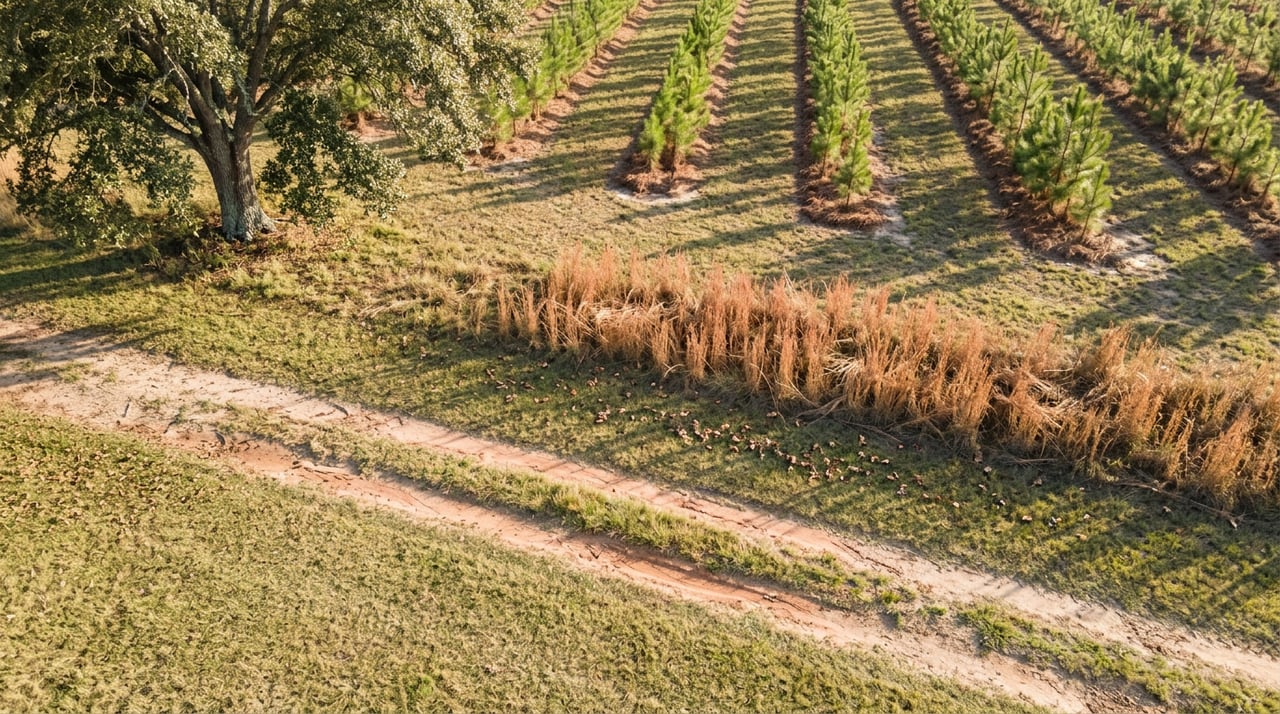
Miss that window and the county assesses the land at fair market value the following tax year, which on a working timber tract can be a significant jump from what the seller was paying. This is a state-level rule, not a Houston County quirk, but it hits differently on the kind of property actually for sale around Gordon: planted pine, row crop ground leased to a local farmer, and pasture that's been in current use for decades. A buyer closing in November on 80 acres of loblolly pine off Mount Zion Road needs to know that clock is already running, because nobody at the closing table is required to tell them.
What's Under the Land Isn't Always Included in the Sale
Alabama allows mineral rights to be severed from surface rights, and in a region with as much land passed down through families as the Wiregrass, older deeds sometimes carry a reservation that never got resolved. A 1950s-era sale that reserved "all oil, gas, and other minerals" to the seller can still be legally enforceable today, decades after everyone involved in that transaction has passed the land down twice more.
This isn't a signal of anything wrong with a particular tract. It's simply common enough in this part of the state that a title search confirming whether mineral rights transfer with the surface should be standard practice, not an extra step reserved for suspicious buyers. If a deed contains language like "excepting and reserving all minerals" or is simply silent where you'd expect that clause to appear, that's worth flagging to a title attorney before closing, not after.
The Corners Nobody Has Confirmed in Decades
Alabama doesn't legally require a survey to close on land. On the tracts actually listed around Gordon right now, that legal minimum isn't good enough in practice. A lot of this inventory is described the way sellers describe it themselves: acreage bordered by "generational farms and timberland," tracts reached by county roads or old logging paths, corners marked, if at all, by a fence line that's been there longer than anyone can confirm was ever surveyed.
Old fence lines are not the same thing as a recorded boundary. A current survey pins the actual corners, confirms the acreage you're paying for matches the acreage on paper, and catches encroachments before they become your problem instead of the seller's. On interior parcels reached by a shared road, a lender's title company. and honestly a buyer relying on nothing more than "we've always used that driveway", need a survey to confirm the access easement is actually recorded, not just customary. Landlocked parcels exist in Houston County, and while access can sometimes be negotiated after the fact, it isn't guaranteed just because the seller drove in and out of the property for thirty years.
There's a real example worth knowing about, since it shows how much a site visit and survey can turn up that a listing photo never will. One tract off Grimsley Road, in the River Road area southeast of Gordon, is mixed pine and hardwood regeneration on upland sandy loam, the kind of soil common across this county. It also has gopher tortoises on it, a detail that shows up because gopher tortoise presence on sandy Wiregrass soils affects eligibility for longleaf pine restoration cost-share programs and prescribed burning plans. That's not a red flag. It can be a genuine asset for a buyer interested in land stewardship programs. But it's exactly the kind of detail that only surfaces when someone walks the property and asks the right questions, not when someone reads the listing description.
A Pre-Closing Checklist for Land Near Gordon
Before signing anything on a rural tract in this area, it's worth confirming:
- The legal description includes a derivation clause and matches recorded plat references, if any
- Marital status of the grantor is stated on the deed, as Houston County requires
- A title search has specifically addressed whether mineral rights are included or severed
- A current survey exists or has been ordered, especially on unfenced or interior parcels
- Recorded access easements exist for any tract reached by a shared road or another owner's land
- Whoever is closing after October 1 understands the current use filing deadline that follows
None of these steps are unusual on their own. What's unusual is how often they get skipped on rural land deals specifically, because buyers and sellers assume land closings work the same way as a house closing. They mostly do. The exceptions are the ones that cost money later.
Does every tract near Gordon qualify for current use valuation? Only land actively producing agricultural products, livestock, or timber for sale qualifies. A homesite carved out of a larger tract, or acreage that's been cleared and isn't being farmed, may not.
If the seller already has a survey, do I still need my own? It depends on the survey's age and whether it matches the current legal description. An older survey can still miss encroachments or boundary shifts, especially on land that's changed hands more than once since it was drawn.
If mineral rights were severed generations ago, does that still matter today? Yes. A severance recorded decades ago typically remains enforceable unless it was specifically reunited with the surface in a later deed, which is exactly what a title search is meant to confirm.
Buying or selling timber, pasture, or river-bottom acreage around Gordon rewards the kind of attention that comes from actually working land, not just listing it. That's the lens Michael Dorriety brings to every rural transaction in the Wiregrass, as someone who runs cattle and poultry on his own farm before he ever runs comps on someone else's. If you're closer to buying or selling land near Gordon than the ads and listing sites are telling you, schedule a free consultation or start with an instant valuation, and get the paperwork right before it becomes a problem instead of after.