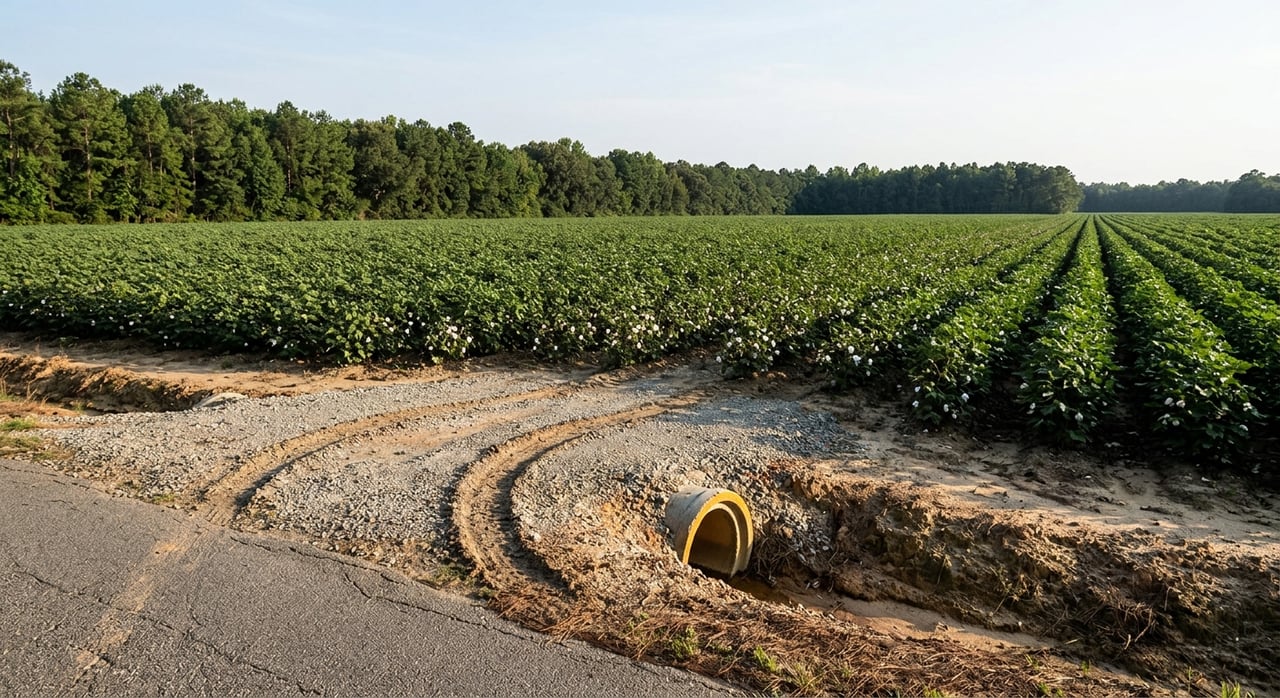
If you have ever looked at two farmland tracts near Geneva and wondered why the price per acre is so different, you are not alone. Buyers and sellers often start with acreage and location, but farmland value usually comes down to how the land can actually be used. When you understand the local factors that shape price, you can make better decisions and avoid costly assumptions. Let’s dive in.
Geneva farmland starts with local use
Geneva County has an active agricultural base, and that matters when farmland comes to market. According to the 2022 Census of Agriculture, the county had 681 farms covering 160,853 acres, with an average farm size of 236 acres and $279.9 million in products sold.
That production mix also helps explain buyer demand. Livestock, poultry, and related products made up 85% of sales, while crops made up 15%, so local buyers may look at land for row-crop potential, pasture use, or a mix of both.
Top crop acreage in the county included cotton, peanuts, forage and hay, corn, and soybeans. Poultry and cattle were the main livestock categories, which means a tract’s value often depends on whether it supports farming uses that fit this local pattern.
Price per acre only tells part of the story
A raw price-per-acre number can be helpful as a starting point, but it is not the full picture. Two tracts with similar acreage in Geneva can carry very different values once you look at soils, drainage, irrigation, access, lease terms, and usable acreage.
That is why buyers usually compare tracts by adjusted value, not just by sticker price. A property with stronger soils, better access, or a cleaner income picture may justify a premium, while one with steeper slopes or more limits may sell at a discount.
Statewide averages can offer context, but they should not be treated as a shortcut to value. Alabama’s 2025 average farmland value was $4,550 per acre, yet Alabama Cooperative Extension System notes that values can differ tremendously across the state.
Soils matter more than many people think
In Geneva County, soil productivity is one of the first things serious buyers review. The county sits in the Wiregrass, where soil map units such as Dothan sandy loam and Troup loamy sand are part of the conversation.
NRCS describes Dothan soils as very deep and well drained, and notes that many areas are used for corn, cotton, peanuts, vegetables, hay, and pasture. Troup soils are also very deep, but they are somewhat excessively drained, which can affect how land performs depending on the intended use.
Even within the same general area, slope and erosion risk can change what a buyer is willing to pay. The county’s highly erodible land guide shows that some slope classes in Dothan, Orangeburg, and Red Bay soil units can become highly erodible.
That means two nearby tracts may look similar from the road but function very differently in practice. For buyers, this affects productivity and management. For sellers, it affects how well the asking price is supported.
Water and irrigation can create a separate market
Water access is another major value driver. USDA land-evaluation guidance looks at more than just soil type, including drainage, irrigation, waterways, and other on-farm improvements.
In Geneva County, 7,156 acres were irrigated in 2022, which was about 4% of land in farms. That does not automatically assign a premium to every irrigated tract, but it does show that irrigated acreage is a limited part of the local farm base.
Because of that, buyers often view irrigated land differently than dryland tracts. If a property has documented irrigation infrastructure and a workable layout, it may appeal to a different pool of buyers than a tract without that feature.
For sellers, this is one area where documentation matters. If irrigation is part of the value story, it helps to show what is in place, how it serves the land, and how many acres benefit from it.
Rental income helps shape value
For farmland buyers, income potential often matters just as much as physical features. ACES notes that cash-rent data are useful for leasing arrangements and production budgeting, and that farmland value data are typically tied to the cash rental rate.
In Geneva County, 2025 cash rent was reported at $158 per acre for irrigated cropland, $63 for nonirrigated cropland, and $36.50 for pastureland. These figures are useful reference points, especially when a tract is leased or when a buyer is comparing possible returns across several properties.
At the same time, ACES warns that county figures may be multicounty averages and should be treated as rough estimates. In other words, rent history can support value, but it does not replace a tract-specific review.
A lease can help or hurt, depending on the details. A market-rate lease may support an income story, while a restrictive or long-term lease may reduce flexibility for the next owner.
Access and layout affect usability
A tract’s shape and access can change value even when soil and acreage look solid on paper. USDA and NRCS appraisal guidance emphasize practical site factors such as drainage, irrigation, conservation improvements, and comparable local data.
In day-to-day market terms, access and tract configuration are often handled as adjustments rather than fixed rules. A property with straightforward road frontage, efficient field layout, and easy equipment movement may compete better than a parcel with awkward boundaries or limited entry.
This is one reason buyers should avoid quick comparisons based on county averages alone. Usability often shows up in the details, and those details can move value in either direction.
What buyers usually want to see
If you are buying farmland in Geneva, you want enough information to understand both present use and future flexibility. The strongest land evaluations usually include a clear picture of the tract’s physical features and income potential.
Here are some of the items buyers commonly review:
- Soil maps and soil productivity information
- Slope, drainage, and erosion considerations
- Irrigation status and the number of usable irrigated acres
- Current or past cash-rent history
- Lease terms, if a tenant is in place
- Buildings, fencing, or other improvements
- Access, road frontage, and overall tract layout
The goal is simple. You are trying to understand what the land can do, not just what it looks like from the road.
What sellers can do to support value
If you are selling farmland, your pricing story gets stronger when you can document the tract clearly. Buyers tend to respond better when the asking price is backed by real information instead of broad claims.
Useful materials often include soil maps, lease history, irrigation details, recent rent figures, and notes about improvements. When those pieces are organized upfront, buyers can compare the property more confidently.
That also helps reduce the risk of underpricing or overpricing. A tract that appears average at first glance may deserve a closer look once its soils, water access, and usability are documented.
Why nearby tracts can price differently
This is one of the most common questions in the Geneva land market. Two properties may sit close together and still bring different prices because they do not offer the same productivity, flexibility, or operating picture.
One tract may have better soils, flatter ground, cleaner drainage, and more practical access. Another may have weaker soils, steeper slopes, limited irrigation, or lease terms that narrow a buyer’s options.
That is why local, tract-specific analysis matters so much with farmland. In a market like Geneva, value is usually tied to use, and use is rarely identical from one parcel to the next.
Why averages should stay in context
County and state averages are useful for setting expectations, but they should stay in their proper place. They are context, not a final answer.
For example, Alabama’s average farmland value and local cash-rent benchmarks can help frame a conversation. But ACES makes clear that these figures can vary materially by county, soil, and use, and some county numbers may reflect multicounty averages rather than one exact local sample.
If you rely too heavily on averages, you may miss what truly drives value on a specific tract. Farmland is not a one-size-fits-all asset, especially in a county with mixed crop and livestock uses like Geneva.
A practical way to look at Geneva farmland value
For most buyers and sellers, the best approach is to combine local market context with tract-level detail. Start with the basics, then work outward: soil, slope, drainage, water, rent history, access, and improvements.
That kind of review leads to better pricing, stronger negotiations, and fewer surprises. It also helps you see whether a property should be viewed as row-crop land, pasture, mixed-use farmland, or something more specialized.
In a place like Geneva, farmland value is rarely about just one number. It is about how the land works, what it can support, and how clearly that story is presented to the market.
If you are thinking about buying or selling farmland in Geneva, working with someone who understands both land and the local market can make the process a lot clearer. Michael Dorriety offers practical guidance rooted in real farm experience and local Wiregrass market knowledge.
FAQs
Why do two Geneva farmland tracts with similar acreage have different prices?
- Soil productivity, drainage, irrigation, access, slope, and lease status can all differ from one tract to another, even when location and acreage look similar.
Does an existing Geneva farmland lease help property value?
- It can, depending on the terms. A market-rate lease may support income, while a long-term or restrictive lease may limit flexibility for the buyer.
What should you review before pricing Geneva farmland?
- Soil maps, irrigation details, drainage, rent history, lease terms, and improvements are all useful when building a clearer value picture.
Are Geneva farmland cash-rent averages enough to price a tract?
- No. They are helpful reference points, but ACES says county figures should be treated as rough estimates rather than tract-specific value.
Does irrigation increase Geneva farmland value?
- Irrigation can make a tract more appealing to some buyers, especially since irrigated acres are a limited share of the county’s farm base, but value still depends on the specific property and documentation.